I was wearing my banana-eating pants
with my apple-thieving shirt that day.
No one could tell me nothing: I thought
I’d be rolling in grapes forever. I had
a little hat I’d made out of a blood
orange peel—it sat on the back
of my head like a Valkyrie. I never
could tell where it all came from,
the fruit clothes and the gumption
to wear them. Maybe I was foolish,
burning myself out like so much
kirsch—how the clean, blue flames
wrap themselves in cherries jubilee.
Tag Archives: writing
Not Really
I’m going to dye my hair tonight,
and that will make everything
everything.
I have faith in these small things:
the tock-tock-tock of my boots
on pavement,
the fact of myself, however I am—
and of you, however you are—
the reunion
of myself with myself when I am
alone sometimes, though not
as lonely as now.
Captain Obvious
Captain Obvious flexes his right forearm, examines it,
says, I’m the kind of person who tells it like it is.
Captain Obvious is made of cottage cheese.
Captain Obvious smells like motor oil. One time,
he took a drive down a long, long highway,
and as he drove, he wrote every song on the radio.
Hornbeam
Whatever else happened between the leaves
or in the hammock, Louise was not about
to stick around to find out. Norman told her
to come for a walk, so that’s what she did,
meeting him in the shade of the hornbeam
tree, admiring its catkins. She always liked it
when a man knew trees: Not just, Meet me
under that big, round shade tree, but
Meet me under the hornbeam. Maybe
Meet me under the hornbeam, Dear
would be better. But there was time
enough for that, she thought, more than
enough evenings left in June, More
than enough Junes left for all that.
No Difference
And when we were boys,
we were boys,
and when we were girls,
we were girls.
When we wore clothes,
we could see each other;
when we took them off,
we became invisible.
We lived in the mud;
we lived in the elbows
of trees, or of each other.
It made no difference.
Here’s the Thing
I never said I didn’t want to move to Denver,
only that I hate mountains and craft beer.
Maybe you misheard; what I actually said
was that I’m not moved by John Denver —
his music or his Grape Nuts commercials.
But Denver is as Denver does, and if you
want me to fly low over all the wildflowers
there, pollinate all those acres of lupines,
then ask me again and I might say yes,
especially if you buy me a craft beer first.
Major Thoroughfares
Channing Tatum, I am
your pretty wife.
Your head is as wide
as a pickle jar,
and your ears are
the handles to all
that I hold dear.
You bite your thumb
at me. Your belly is
made of arthropods
under a skin as slick
as any seal’s. I’ll tie
your bow tie for you;
then, let’s measure
your waist and my arm,
my index finger and your
eye socket, my avenues,
your boulevards, all the
major thoroughfares we
haven’t traveled yet.
But I have an ISBN! Chapbooks and the Imposter Syndrome
As you might have heard a bajillion times, my first chapbook has now been published by Evening Street Press, and I’m really excited about it.
But.
If you’re a poet yourself, maybe you’ve read some things about chapbooks and how tough they are to place in bookstores because most bookstores really, really hate them. I didn’t want this to be true — but I’m finding it to be pretty true so far.
Likewise, I don’t know what I thought would happen when I opened my box of author copies. Maybe something like that scene in Pulp Fiction when they open the briefcase or whatever it is, and there’s a mysterious, almost celestial glow?
I guess I expected some type of self-validation, like the song in the Tony Randall movie Will Success Spoil Rock Hunter? that repeats over and over that the main character has “got it made!” and just what a swell, successful guy he is.
Did I think I would no longer be as conscious of the fact that I lack an MFA, and that I am trying to combine my artistic life with a boatload of other stuff? Was finally getting a chapbook published going to put an end to my tendency to compare myself against others — to read contributors’ bios and imagine my fellow poets ensconced in their bookshelf-lined writing rooms or on rustic and deeply fulfilling sabbaticals when they’re not igniting the fire for the next generation of creative young minds? (I know, I know … my fantasy probably does not equal many creative academics’ reality.)
The truth is, whatever level of success I (and perhaps you, too) achieve with my writing, there will always be someone who’s doing more. Oh, look — I have a chapbook, but this other person has a book. Like, a full-on, 60-page book. It’s not much thicker than my chapbook, but there it is. It’s on the shelf right in front of me, in fact — because books do get on bookstore shelves. So what I really need to do is … get a book published. And that’s when I’ll feel like a real poet. Right?
Oh, imposter syndrome, I know you from so many other parts of my life, and yet you always seem so true.
So, how do I get out of this funk and back to being over-the-moon ecstatic about this great thing that has happened, this wonderful gift that I should never take for granted or downplay to myself? How can I quit — just for a little while — looking ahead to the next hurdle and the next and the next? That’s the million-dollar question right there. All I can say is stay tuned.
And if you’ve ever felt this way, too — that some other writer has achieved x, y, and z and is therefore “the real deal,” that there’s some magic something that they have and you don’t … just know that you’re not alone. This may be, in fact, as much a part of many creative writers’ lives as SASEs and submission fees. Maybe the key is to acknowledge that and just keep pushing forward.
(Note: I’m not putting in any links because I just want to get this out, but I encourage you to Google or YouTube both film references and “imposter syndrome,” and … OK, I can’t resist this one link, in case you don’t know the deal about my chapbook, and this other one because Evening Street Press deserves to be recognized.)
Shoehorn
Hylbert Masserdine woke up,
stretched, said, “Mornin'”
to himself in the mirror,
extended one long arm
over the bed until
he found his favorite
shoehorn, the one with
mother-of-pearl inlay
in the shape of his own
mother, or what he imagined
his mother to be. He wrestled
each toe into its location,
his thoughts into the right
rhythm. He always felt like
he could do anything, once
he had his shoes on, once
everything was right again, the
nastiness of sleep shaken off,
all its perpetual quakings, its
cavalcade of nameless want.
Oh, and hey, don’t forget: My chapbook Secret Rivers is available now.
My First Chapbook Is Here!
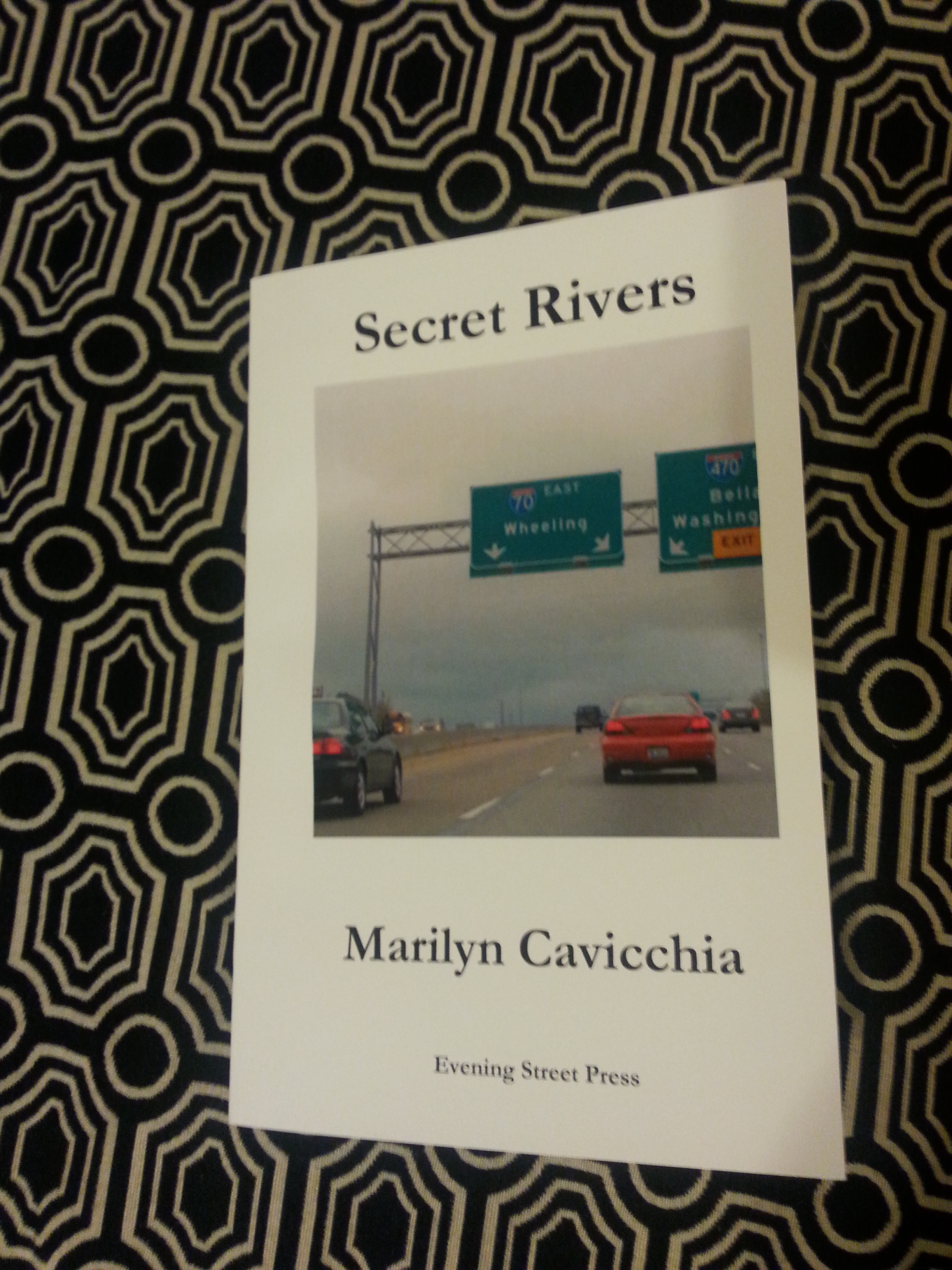
It’s sitting right next to me on the couch, in fact. Shouldn’t it be next to you — or in your hot little hands? Here are a few ways you can make that happen:
- Order it from the fabulous Evening Street Press (where you should also order some of the other chapbooks, and their Review),
- Order it from Amazon, or
- Email me here: marilyn [dot] cavicchia [at] gmail [dot] com.
If you go for option #3, I’ll even autograph it for you — for FREE. I’ll spring for the postage, too, and then at some point, you mail me $10.
What sort of poetry is in Secret Rivers? It’s made up of persona poems in which the speakers are either driving or riding in vehicles on a particular stretch of highway in Ohio. I didn’t start out with any particular intention, but because of the area I was describing, a narrative thread emerged that deals with fracking (hydraulic fracturing for oil and gas). My opinions of this practice are probably clear, but I tried to be balanced and respectful, and to let all my personas have their say — whether they agree with me or not.
I hope you’ll enjoy Secret Rivers. And if you happen to live in Chicago or Columbus, watch this space for news about upcoming readings.
 Marilyn Rauch Cavicchia